
Trisha Studios
Knowledge Centre
Why ACES Was Created
In the early 2000s, the Academy of Motion Picture Arts and Sciences identified a problem that was becoming increasingly acute as digital acquisition replaced film: there was no universal standard for how digital images should be encoded, exchanged, and archived. Different camera manufacturers used different colour spaces, different log curves, and different metadata conventions. Images created for theatrical projection looked wrong on broadcast monitors. HDR standards were emerging with no agreed common reference.
The solution was ACES: a universal colour science framework that operates independently of any specific camera format, display technology, or delivery standard. The Academy convened manufacturers, studios, facility operators, and engineers to create something that would serve the industry for decades — not just solve the immediate interoperability problem.
ACES 1.0 was published in 2014. The current version is ACES 1.3. It is now used by virtually every major post-production facility serving the feature film and streaming industry.
The ACES Architecture
ACES defines three primary colour spaces. ACES AP0 (Academy Primary 0) is the archival and interchange space — its gamut is larger than any camera or display can represent, ensuring that no colour information is discarded in interchange. ACES AP1 (Academy Primary 1), also called ACEScg, is a working space used for rendering and compositing — a practical subset of AP0 that covers the full visible spectrum. ACEScc and ACEScct are logarithmic variants of AP1 designed for colour grading, providing the gamma curve that colourists expect when working with colour wheels and curves.
The grade itself happens in ACEScct: the colourist adjusts shadows (lift), midtones (gamma), and highlights (gain) using the same conceptual approach as a traditional film grade, but within a colour-managed, scene-linear framework. The result — the grade data — is stored in ACEScct.
Input Transforms (IDTs, also called Input Device Transforms) convert each camera's native colour science into ACES AP0. There is an IDT for every major camera format: ARRIRAW, RED, Sony Venice, Blackmagic, Canon RAW. These transforms are maintained by the camera manufacturers and the Academy and are updated as camera formats evolve.
Output Transforms (ODTs, also called Output Device Transforms) convert the graded ACES values into the signal required by a specific display. An ODT for Netflix HDR converts to Rec.2020 PQ (the container for both Dolby Vision and HDR10). An ODT for theatrical projection converts to DCI P3 with DCI white point. An ODT for broadcast converts to Rec.709.
Practical Implications for Your Production
The most important practical implication of an ACES pipeline is deliverable flexibility. If your grade is created in ACES, adding a new output format means adding a new Output Transform — not regrading. When Netflix introduces a new HDR format in 2028, or when a theatrical partner requires a format that does not currently exist, the ACES master grade can be used to generate the new deliverable without creative rework.
The second implication is archival integrity. An ACES archive is future-proof in a way that a display-referred archive is not. A grade stored in Rec.709 is permanently tied to the SDR display standard — re-mastering it for HDR requires significant manual work. A grade stored in ACES can be re-mastered for any future standard.
The third implication is cross-facility consistency. If your production moves between facilities — if additional grading is required at a second location, if a series has different episodes graded at different facilities — an ACES pipeline ensures that the colour science is consistent. The same IDTs and ODTs produce the same result regardless of which ACES-compliant system they run on.
Common Questions
Does ACES add cost to a production?
The initial setup of an ACES pipeline requires careful technical preparation, but the ongoing workflow is not significantly more complex than a non-ACES pipeline. The investment is in configuration and verification — ensuring that all IDTs are correctly applied and all output transforms are calibrated. For productions with multiple deliverables, ACES typically saves time overall by eliminating re-grading for different output formats.
Is ACES required by streaming platforms?
ACES is not mandated by any platform — but the technical requirements of platforms like Netflix effectively require an ACES-compatible workflow to produce simultaneous Dolby Vision and HDR10 deliverables from a single grade reliably. Practically, ACES is the most efficient path to multi-deliverable finishing.
ACES Pipeline at Trisha Studios
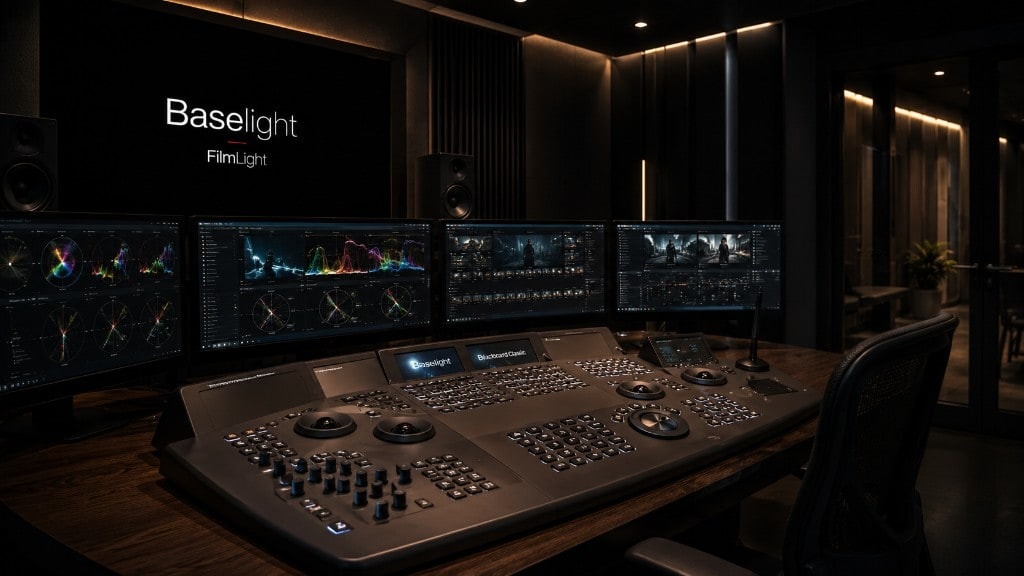
Our FilmLight Baselight runs a complete ACES pipeline — from camera input through HDR grading to simultaneous multi-format output.
See Our Technology