
Trisha Studios
Knowledge Centre
The Global Adoption
FilmLight Baselight is the colour grading system used to finish Oppenheimer, Killers of the Flower Moon, The Irishman, Dune, and most of the world's most acclaimed feature films. It is also the system used in leading post-production houses across London, Los Angeles, New York, Sydney, and Mumbai. This is not brand loyalty — it reflects specific capabilities that matter when the stakes are high.
Understanding why Baselight became the standard for demanding productions requires looking at what those productions actually demand: accuracy across multiple camera originals, management of complex multi-deliverable output, a colour science architecture that separates the grade from the output format, and the ability to handle scale — features covering hundreds of scenes, each with its own technical requirements.
Colour Science Architecture
Baselight's fundamental architecture separates the grade from the display. When you grade on Baselight, you work in a scene-referred colour space — meaning the colour values represent actual light in the scene, not a specific display's interpretation of that light. Output to HDR10, Dolby Vision, standard dynamic range for broadcast, or DCI P3 for theatrical projection is managed through the colour management system, not by changing the grade itself.
This architecture — which underpins the ACES (Academy Colour Encoding System) framework — means that a grade created for Netflix streaming in 2026 can be re-mastered for a different format in 2030 without returning to the original grade and making manual adjustments. The creative decisions are preserved; the output transform changes. For productions with long distribution tails, this is not a minor technical advantage.
Competing systems — including DaVinci Resolve, which is an excellent tool for many applications — can be configured to work in ACES, but Baselight's integration of colour science at the system level means that colour management is not a workflow choice but the default operating mode. The colourist cannot accidentally grade outside of the managed pipeline.
The Layer Stack
Baselight uses a layer-based compositing model rather than a node graph. This has specific practical advantages for feature film work. A complex shot correction — say, a visual effects element that needs to integrate with location-shot material, which itself has a base exposure correction, a creative look, and a qualifier-driven sky grade — is organised as stacked layers, each addressable independently, with clear visual hierarchy.
For operators who have spent years building Baselight workflows, this organisation becomes intuitive. Corrections at one layer can be scoped to affect only the layers below it. Masks, qualifiers, and tracking data are all managed within the same environment. The result is a grade that is both complex (when complexity is needed) and auditable — a new operator joining a project can understand what each layer is doing and why.
Multi-Site and Collaboration
For large productions — streaming series with multiple episodes graded simultaneously, international co-productions with facilities in different countries — Baselight's multi-site capabilities allow consistent grading across facilities sharing the same colour science configuration. A look established in one city can be applied reliably in another.
The Baselight Editions plug-in for editorial systems (Avid Media Composer, Adobe Premiere, DaVinci Resolve) allows dailies and editorial proxies to carry colour information that translates directly to the finishing suite. The gap between what editorial sees and what the DI suite delivers is closed.
What This Means for Your Production
Baselight supports managed colour workflows and multiple output formats. The exact delivery specification still needs to be confirmed with each platform or distributor.
More practically: the grade is future-proof. Whatever new delivery format emerges in five years, the colour information created in your Baselight session will be re-masterable. Your film is not locked to the display technology of the day it was finished.
Common Questions
What is the difference between Baselight and DaVinci Resolve?
Both are professional colour grading systems capable of outstanding work. Baselight is built around colour science architecture — scene-referred grading, ACES integration, multi-deliverable management — and is the dominant tool in high-end feature film finishing facilities globally. DaVinci Resolve is a complete post-production environment (editing, colour, VFX, audio) and is widely used for independent production, commercials, and broadcast work. The choice depends on the production's requirements.
Does the grading system affect the final image quality?
Directly: no. Both systems can produce equivalent image quality from the same source material. What differs is the workflow — how colour science is managed, how complex corrections are organised, and how reliably the grade can be output to multiple specifications. For productions with demanding requirements across multiple deliverables, Baselight's architecture provides measurable advantages.
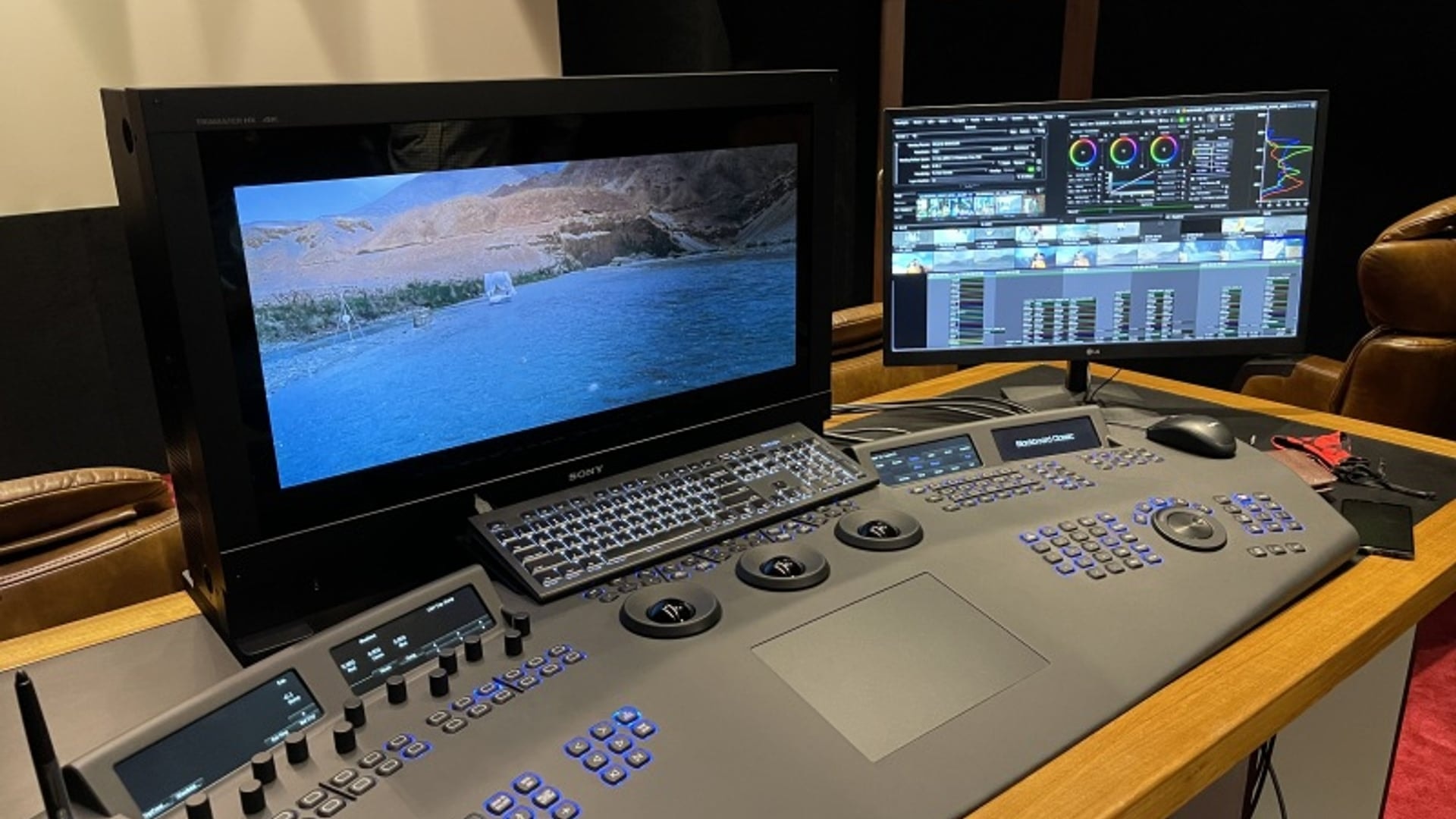
FilmLight Baselight. At Trisha Studios Mumbai.
Baselight with Blackboard Classic for feature, OTT and broadcast colour grading, with HDR and SDR mastering.
See Our Colour Grading Services